.png)
Yoga for Hikers: Build Strength, Balance and Mobility for Better Hiking
Written by Jackie Paunil, Creator of the Young Heart Yoga App, E-RYT, RPYT, CHC, MFA
Empowering older adults to move, breathe, and thrive with grace and vitality.
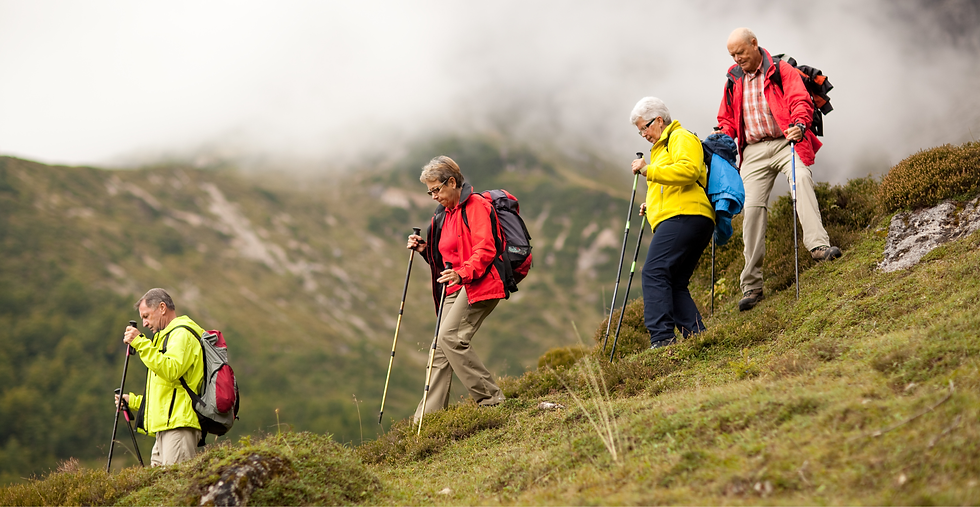
Hiking is wonderful exercise for older adults. It builds cardiovascular endurance, challenges the legs, gets us outdoors, and gives us something a treadmill simply can't: scenery.
But hiking also asks a lot of our bodies.
Uneven terrain, hills, descents, rocks, roots, and long stretches of repetitive movement challenge the ankles, calves, hamstrings, quadriceps, glutes, hips, and core. That's where yoga for hikers can become a valuable complement to your hiking practice.
Hiking Is Fantastic Exercise—but It's Not the Whole Picture
Hiking develops endurance and challenges strength and balance, but the repetitive nature of walking—particularly on uneven or steep terrain—can place considerable demands on the musculoskeletal system.
A survey of 1,295 long-distance Appalachian Trail hikers found that 61% reported a musculoskeletal complaint, while 28% reported an overuse or chronic injury. Importantly, hikers who reported pre-hike conditioning were less likely to report musculoskeletal injuries. Strength training, stretching or yoga, and endurance training were each associated with fewer injuries (Chrusch & Kavin, 2021).
There's an important distinction here: the study shows an association, not proof that yoga prevents hiking injuries.
Still, it makes a good case for preparing your body before asking it to carry you up a mountain.
What Yoga Adds to Hiking
Yoga can complement hiking by focusing on areas that may benefit from mobility, balance, controlled strength, and body awareness.
Research involving older adults has found that yoga can improve balance, flexibility, and muscle strength (Ko et al., 2023).
Another meta-analysis found moderately positive effects of yoga on muscle strength, balance, mobility, and lower-body flexibility in older adults. Interestingly, yoga did not significantly improve cardiorespiratory endurance in that analysis (Shin, 2021).
And that is exactly why I like the combination.
Hiking builds endurance. Yoga can complement the mobility, balance, flexibility, and body awareness that help you move well.
You don't have to make yoga and hiking compete for your attention. They can support each other.
Five Yoga Movements Hikers Can Use
You don't need a 90-minute yoga class to benefit. A few thoughtfully chosen movements can become part of your preparation or recovery.
1. Mountain Pose With Foot Awareness
Stand tall and notice your feet.
Feel the three points of contact—the heel and the base of the big and little toes. Notice how your weight is distributed.
It sounds simple.
That's the point.
Your feet are your foundation on the trail.
2. Chair-Supported Warrior II
Use a chair for support and practice Warrior II while paying attention to the alignment of your knees, hips, and ankles.
This can provide a gentle opportunity to work on leg strength and stability without turning the practice into a balancing circus.
3. Supported Low Lunge
A supported lunge can gently explore hip-flexor mobility, which may feel particularly welcome after hours of walking.
Keep the movement comfortable rather than forcing a deeper stretch.
4. Calf and Ankle Mobility
Try slow ankle circles, supported heel raises, or gentle calf stretching.
Your ankles encounter plenty of surprises on a trail. Giving them some attention off the trail makes sense.
5. Figure-Four or Seated Hip Stretch
A supported figure-four or seated hip stretch can provide a comfortable way to explore hip mobility without requiring you to get down on the floor.
And yes, sometimes getting back up is the harder part.
Don't Forget Strength
Yoga is valuable, but hikers should also include progressive strength training appropriate to their abilities.
Hiking doesn't necessarily provide all the resistance stimulus needed to maintain or build muscle. And yoga shouldn't be expected to replace every other form of exercise.
Think about strengthening the muscles that help you climb, descend, stabilize, carry a backpack, and maintain your balance.
Squats or sit-to-stands, step-ups, calf raises, hip-strengthening exercises, and appropriate resistance training can all complement your hiking and yoga practices.
Balance Practice: Because the Trail Doesn't Provide a Perfectly Level Yoga Mat
One of the wonderful—and occasionally humbling—things about hiking is that the ground doesn't care about your balance goals.
Roots appear.
Rocks roll.
The trail narrows.
Your foot lands somewhere you didn't quite expect.
Yoga can give older adults an opportunity to practice controlled balance in a predictable environment. Research supports improvements in balance and mobility from yoga-based exercise among adults 60 and older (Youkhana et al., 2016).
That doesn't guarantee you'll never stumble on a trail.
It does give you another opportunity to practice paying attention to where your body is in space.
Prepare, Hike, Recover—and Enjoy the View
A good hiking practice isn't simply about getting stronger so you can hike farther.
It's about being able to enjoy the experience.
Warm up.
Train your strength.
Practice balance.
Maintain mobility.
Pay attention to recovery.
And give yourself permission to slow down when your body asks for it.
For older adults especially, the goal doesn't have to be conquering the biggest mountain or setting a personal speed record.
Maybe the goal is reaching that beautiful overlook, taking a deep breath, and thinking:
"I'm really glad I can still do this."
That's functional fitness at its best.
Take Yoga With You—Even When You're Off the Trail
Young Heart Yoga was created for older adults who want to keep moving, exploring, and participating in the activities they enjoy.
If hiking is part of your life—or something you'd like to return to—yoga can be one useful piece of your movement practice.
Download the Young Heart Yoga App and create an account to practice yoga and meditation designed with older adults in mind. You can practice from home, while traveling, or wherever your next adventure takes you.
You don't need to choose between being a hiker and being a yogi.
You can be both.
And if your legs complain after the hike, well... that's between you and the mountain.
About the Author

Jackie Paunil is a published author, wellness advocate, and creator of the Young Heart Yoga App, designed for active and older adults seeking balance, vitality, and mindfulness. With certifications including E-RYT, RPYT, CHC, and an MFA, Jackie combines her extensive training and life experience to inspire others to live with purpose and wellness.
Residing on a ranch in Casa Grande, Arizona, Jackie leads an organic lifestyle surrounded by animals she adores. She is a devoted wife, mother, proud “GiGi” to her grandchildren, and a world traveler who has explored the depths as a master scuba diver. Her in-person yoga and meditation classes, alongside her app, reflect her passion for helping others thrive. Jackie's teaching philosophy is grounded in her own holistic practices, empowering students to embrace sustainable, joyful movement and mindfulness for a more vibrant life.
References
Chrusch, A., & Kavin, M. (2021). Survey of musculoskeletal injuries, prehike conditioning, and on-trail injury prevention strategies self-reported by long-distance hikers on the Appalachian Trail. Wilderness & Environmental Medicine, 32(3), 322–331. https://doi.org/10.1016/j.wem.2021.04.004
Ko, K.-Y., Kwok, Z. C. M., & Chan, H. Y.-L. (2023). Effects of yoga on physical and psychological health among community-dwelling older adults: A systematic review and meta-analysis. International Journal of Older People Nursing, 18(5), e12562. https://doi.org/10.1111/opn.12562
Shin, S. (2021). Meta-analysis of the effect of yoga practice on physical fitness in the elderly. International Journal of Environmental Research and Public Health, 18(21), 11663. https://doi.org/10.3390/ijerph182111663
Youkhana, S., Dean, C. M., Wolff, M., Sherrington, C., & Tiedemann, A. (2016). Yoga-based exercise improves balance and mobility in people aged 60 and over: A systematic review and meta-analysis. Age and Ageing, 45(1), 21–29. https://doi.org/10.1093/ageing/afv175
Comments